
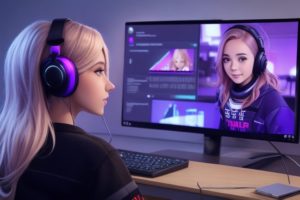
 The vast popularity of Twitch (and live services in general) needs to be taken into account in the field of Youth Work. Twitch’s enormous user base can be tempted to join online projects and form strong communities that can last for a very long time. Furthermore, streaming publicly can give your projects a massive boost of popularity while limiting the possible participation of the extra unwanted audience to avoid potential concerns if you wish.
What is Twitch?
Twitch is a live streaming service that includes in-real-time broadcasts of competitions, music, creative content, events, and “daily life” streams. This platform’s popularity keeps rising year by year. At the start of 2020, it reached an average of 3 million broadcasters monthly and 15 million daily active users, with 1.4 million of the latter connected simultaneously. The numbers have not ceased to grow since then. It shows more usage than social media platforms such as TikTok, Snapchat, and Discord.
Even though an essential portion of Twitch’s community is mainly interested in the gaming category, the platform is no stranger to other sections like Radio shows, Health, Talk shows, Fitness, Traveling, Creativity (art, crafting, cooking), and even experimental sections such as Social eating.
According to statistics, the average Twitch user is between 16 and 34 years old (65% of which are male), and a 2017 survey made by Twitch itself revealed that the platform seems to be used to get entertainment, follow important events, and to have a better alternative to television.
It is not uncommon to gather donations and funding while broadcasting engaging content. Around 7.2% of the users donate to streamers occasionally, 10.1% subscribe to the monthly donation service, and 10.3% do both.
How could Twitch be used to promote intercultural exchange activities?
Quite interestingly, intercultural exchange on Twitch is already happening as you read this article. The entirety of the United States covers around 20% of the total audience. Many countries in Europe (such as France, Italy, the United Kingdom, and Germany) cover 5% each, and even though it has been banned in China, many users come from Japan, Russia, and other countries in Asia as well.
YouTube live streaming is a Twitch alternative with a smaller user base. Yet, here is an example of a recent stream with just ~400 people on a live YouTube streaming where the host gets surprised at how many countries the audience is coming from (I suggest you watch from 45:50 to 49:00).
 Major streaming can see more than 100 thousand users being hosted simultaneously, coming from all the aforementioned countries and more at the same time! Each live stream has its text message board (chat) that the users will take advantage of to interact with the streamer and each other. The streamers are usually very open to receiving and interacting with the user base by answering out loud on what’s happening in the chat, further boosting the process. This phenomenon helps grow a strong community that can stay strong even outside of Twitch by creating Discord servers and even participating in face-to-face gatherings. It’s not uncommon to see such communities develop a substantial amount of neologisms and jokes to the point it feels like they created their own culture.
To reiterate, thousands of people from different backgrounds communicate and attempt to convey their attitudes and thoughts simultaneously in every stream.
The chat can also be managed to quickly address potential users who join public streaming with ill intentions before they damage the community so that the streaming can be made a safe space.
Finally, all the streams can be saved and downloaded to be uploaded (entirely or partially) to other social media. Many gather more popularity by uploading the stream on YouTube or just small clips of the content on TikTok, Twitter, and Instagram.
What conclusion could we gain from this analysis?
Many young people do not find the idea of taking part in online Youth Exchanges appealing since getting engaged and being active in front of a device for a long time gets tiring. At the same time, Twitch’s audience watches live streams for many hours easily and without feeling drained, even though the level of participation needed is usually less than what activities made by Youth Workers and Youth Leaders require. Could that be the discriminating criteria? The answer is up to discussion. What is clear is that in the Youth Work environment, Twitch contains substantial untapped potential.
Are you interested in starting streaming? Check out the Toolbox!
Author: Fabio Costa
Images: Leonardo AI


1 Comment.
[…] streaming website that hundreds of millions of users use worldwide. Since we already discussed its untapped potential, it’s now essential to understand how to use this platform in Youth Work to its full extent. What […]